
Wizecare
A digital health platform enabling physical therapists to treat and monitor patients remotely - from a Microsoft Kinect prototype to adoption across major HMOs.
WizeCare is a digital health platform that enables physical therapists to treat and monitor patients remotely, while patients can access guided therapy anytime and anywhere. The idea originated with the use of the Microsoft Kinect camera and its skeleton tracking technology to analyze patient movement and posture - an innovation that evolved into a comprehensive platform adopted by leading HMOs worldwide.
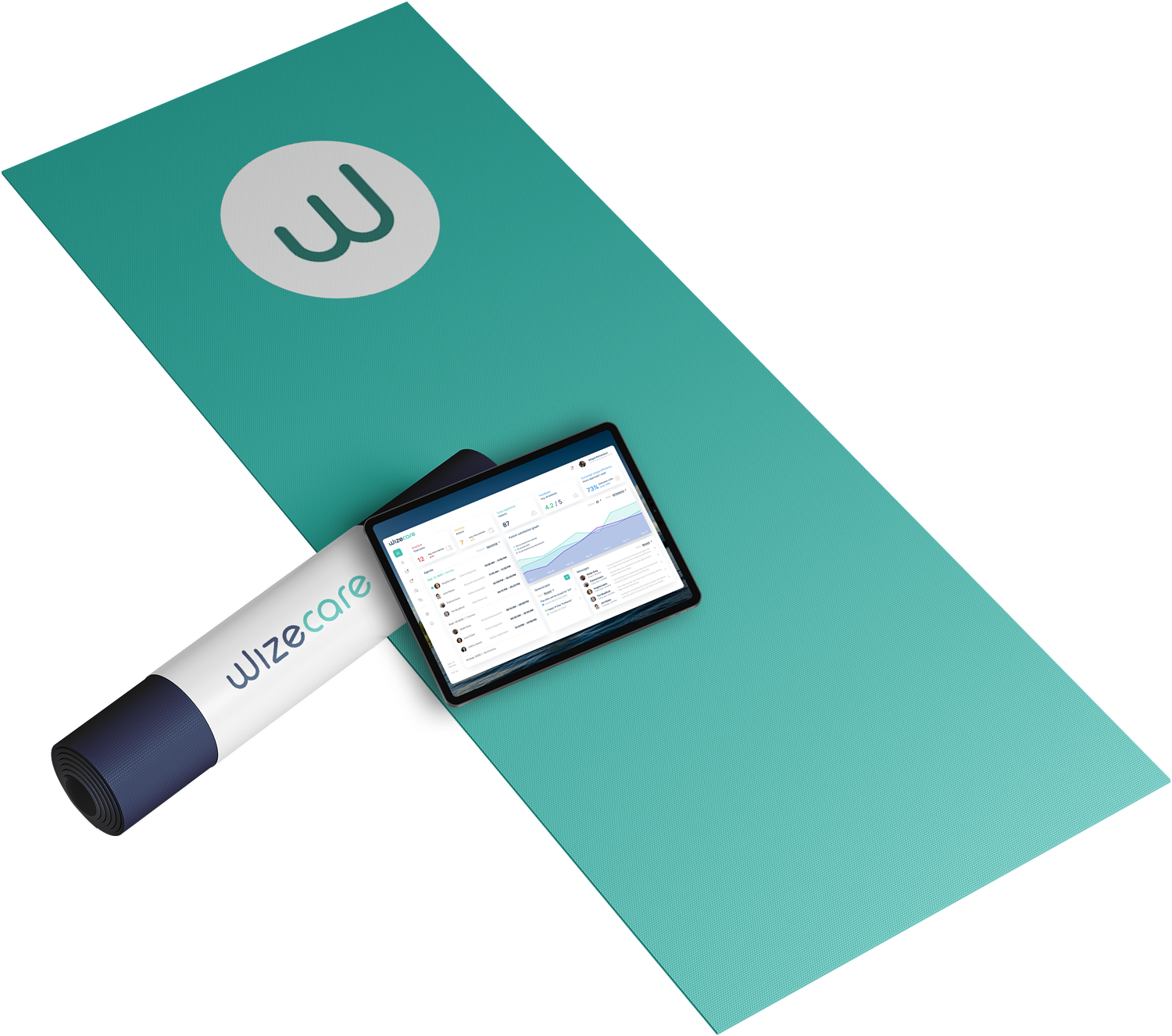
Building a platform that helps PTs manage larger caseloads efficiently, reduce unnecessary rehab costs, and strengthen patient trust through transparent progress tracking and tailored exercise programs.
As both Product Designer and PM, I designed the flows, MVP, and GA release while leading strategy and roadmap. I validated with PTs and patients, and drove Product-Led Growth through CSAT feedback loops.
Problem statement 01
Insurance Exposed to Rehab Fraud
Insurance companies often pay for PT sessions without being able to verify whether claimed rehab hours were truly necessary. Some therapists may exploit this by submitting inflated or false reports, causing financial losses for insurers.
What is the problem?
Unverified rehab plans
Who is affected?
Insurance companies
Why it's a problem:
Fraud risk & money loss

Problem statement 02
Adherence Gap in Physical Therapy
Most rehab (70–80%) happens outside the clinic, yet up to 65% of patients don't follow their programs properly. This leads to misreporting, longer recovery times, and disputes with insurers.
What is the problem?
Adherence gap
Who is affected?
Physical therapist, patients
Why it's a problem:
Slower recovery, higher costs

Problem statement 03
Limited Visibility Beyond the Clinic
Clinic managers struggle to monitor the full rehab journey. They must assign the right PTs to the right patients, yet most of the process happens unmonitored outside the clinic.
What is the problem?
Lack of patient risk management
Who is affected?
Clinic manager, patients
Why it's a problem:
Patient complaints, revenue loss

Contextual Inquiry
Observed therapists' daily tasks (assessments, rehab planning, documentation) and measured time spent.
Mapped their digital workflows to understand which systems they use.
Identified adoption barriers to design smoother onboarding for the new app.
Learned that the full patient rehab journey is the common ground across all PTs' work.

Qualitative Research
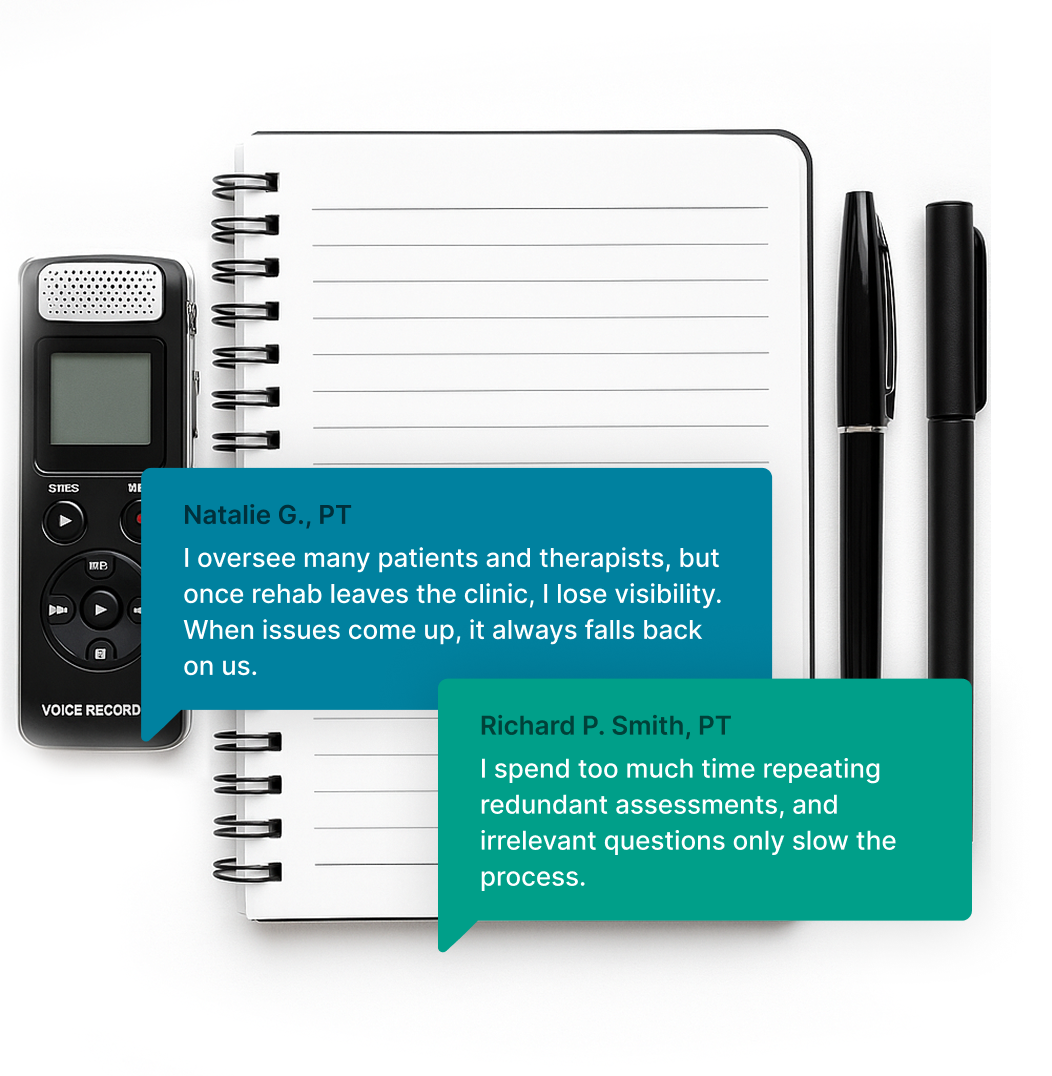
Interviewed a wide range of stakeholders: clinic managers and physical therapists in various roles.
Covered diverse patient groups: elderly, sports injuries, work-related injuries, and children.
Conducted interviews across two major Israeli health organizations - Maccabi and Meuhedet.
Conducted additional interviews with private clinics in Israel and held online sessions with physical therapists from U.S. clinics.
"I oversee many patients and therapists, but once rehab leaves the clinic, I lose visibility. When issues come up, it always falls back on us."
Natalie G., PT
"I spend too much time repeating redundant assessments, and irrelevant questions only slow the process."
Richard P. Smith, PT
Key findings from research highlighting barriers to adoption, efficiency, and trust.

01
Low Trust in TechnologyConcern over losing the human touch in digital care experiences.

02
Time-Constrained InteractionsMust reassess patients multiple times per rehab journey.

03
Felt Unnatural and Time-ConsumingPTs prefer face-to-face care; app felt unnatural & time-consuming.

04
Aligning Diverse PT WorkflowsFrom planners to manual therapists and device-based practitioners.

05
Immediate Value & Quick DeliveryPhysical therapist must gain key clinic insights in minimum clicks.
Step 01
Served as both PM and Designer on this project.
Conducted competitive research to understand market positioning.
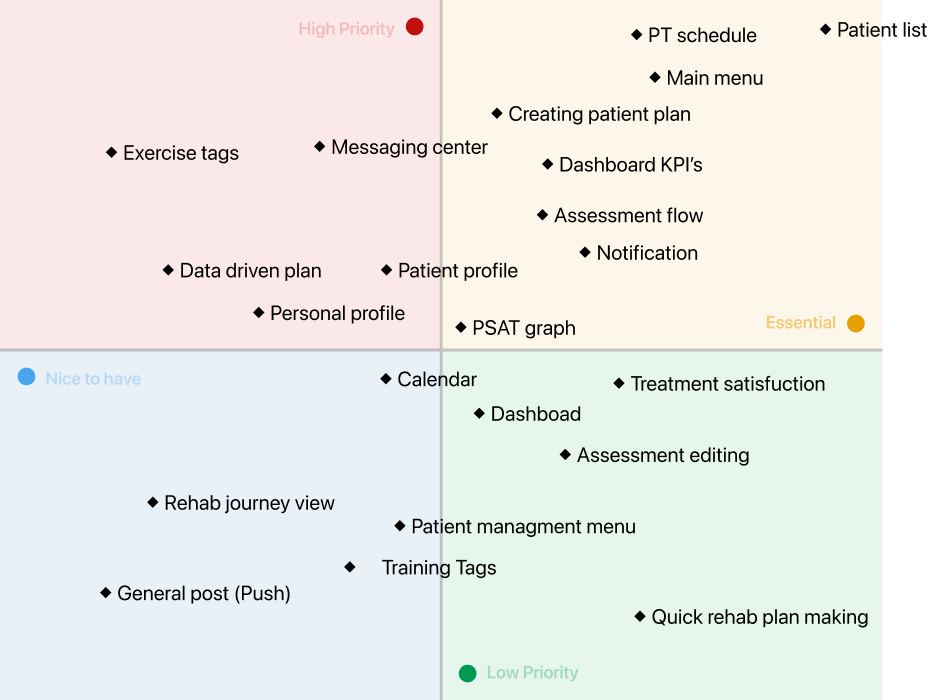
Built a prioritization matrix to define MVP scope and future roadmap - balancing essential features (patient management, assessment flow, data-driven plans) against nice-to-haves.
Step 02
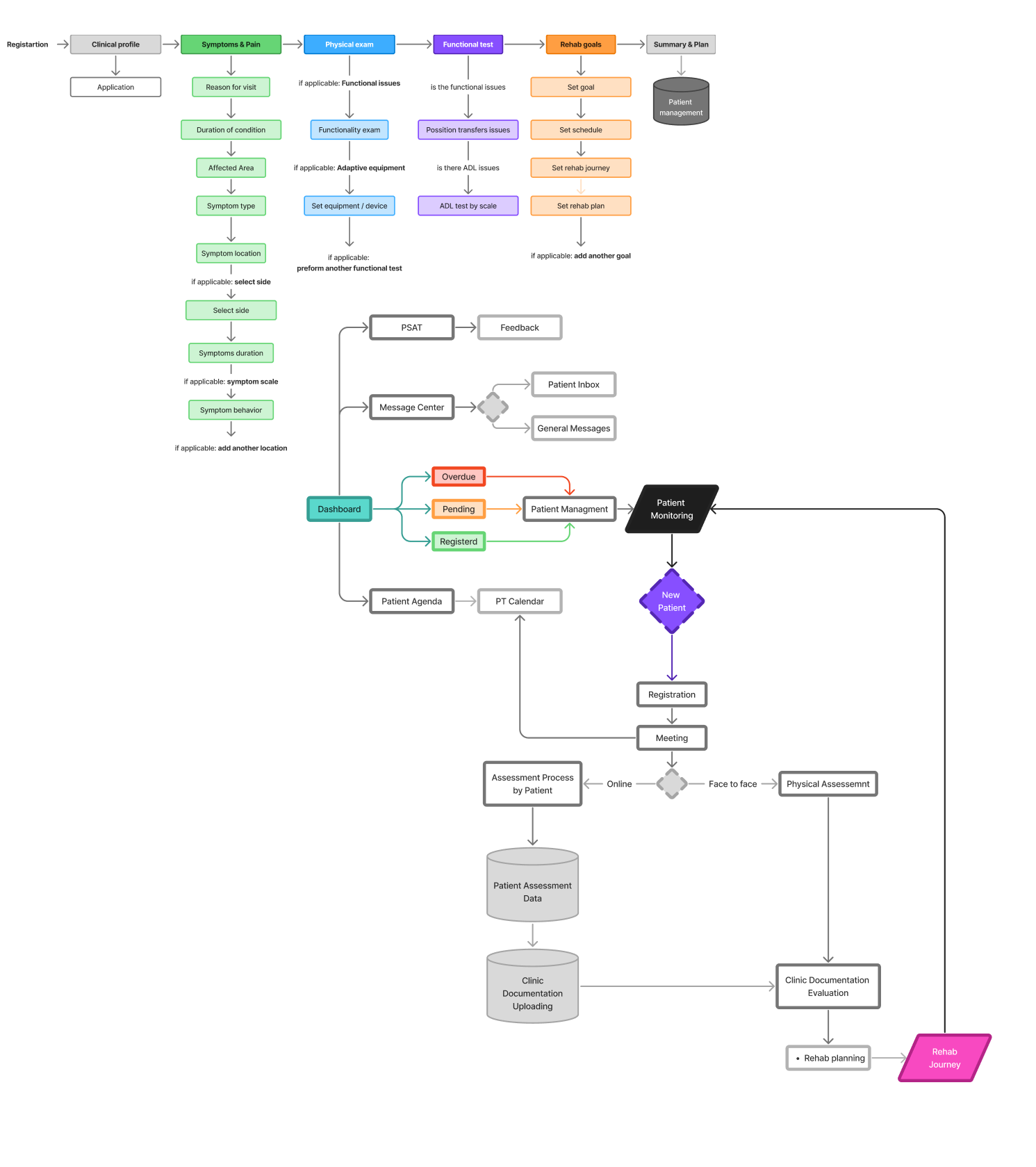
Translated strategic decisions into a clear experience path.
Validated task order and exposed friction points early.
Bridged strategy to data architecture - defining what information supports each step before touching structure.
Step 03
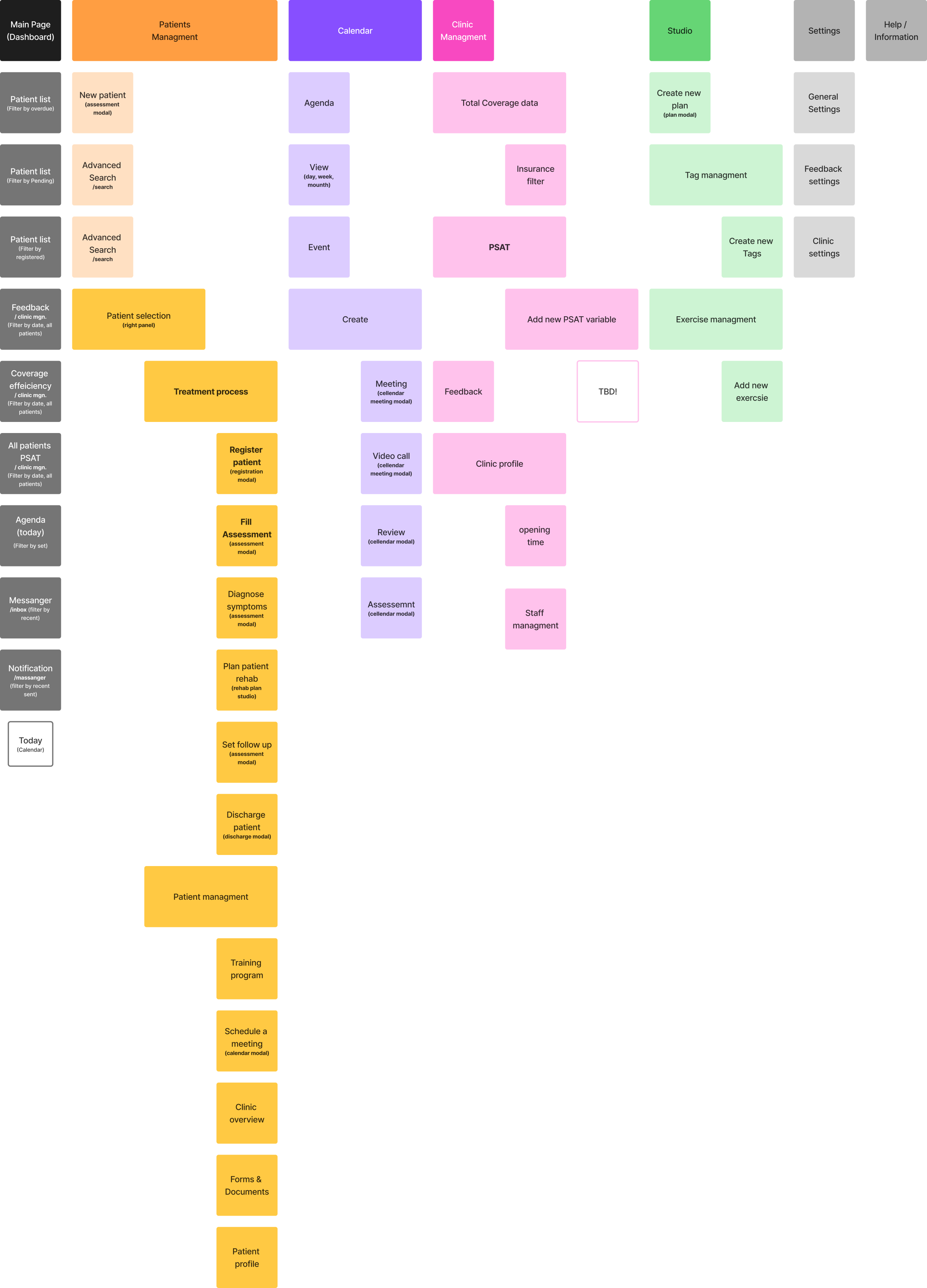
Structured the system's information hierarchy to define how patient data, assessments, and treatment plans connect across modules.
Ensured consistency, scalability, and smooth data flow between users and features.
Step 04
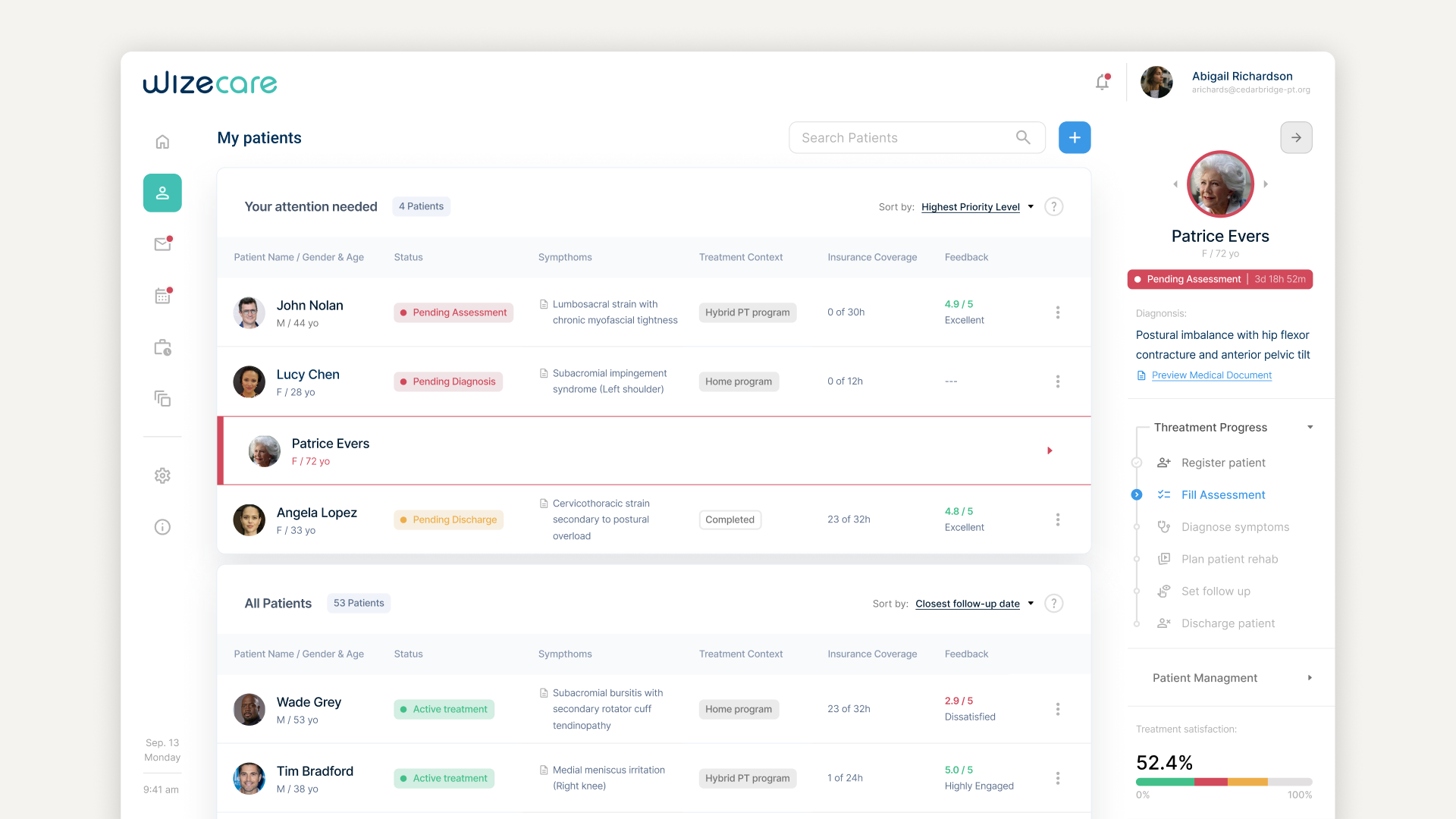
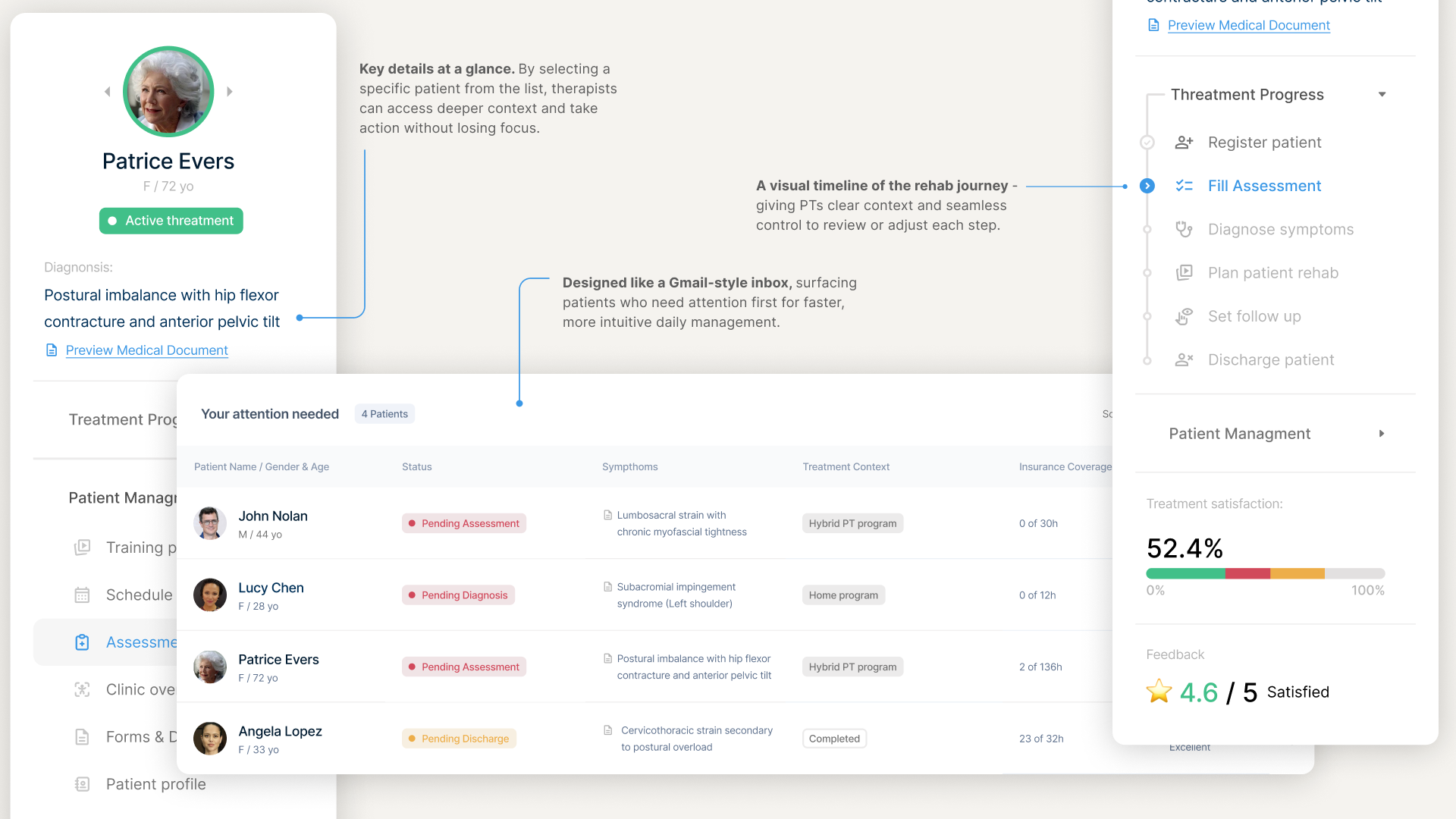
This was the first screen I designed for the platform - chosen intentionally, not by convention. While most start with a dashboard, my research showed that patient management is the most frequently used and impactful area in a PT's daily workflow.
Step 05
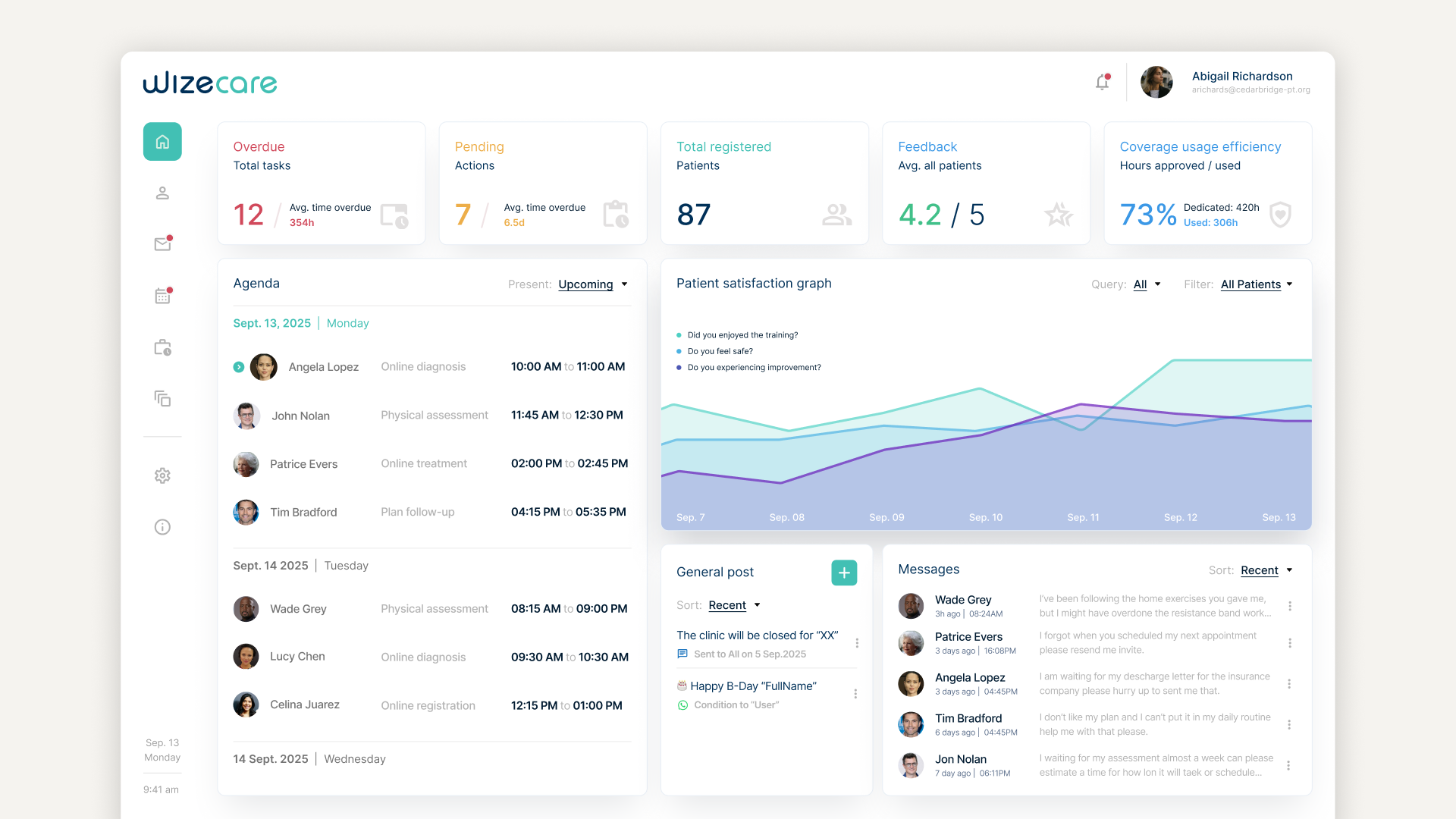
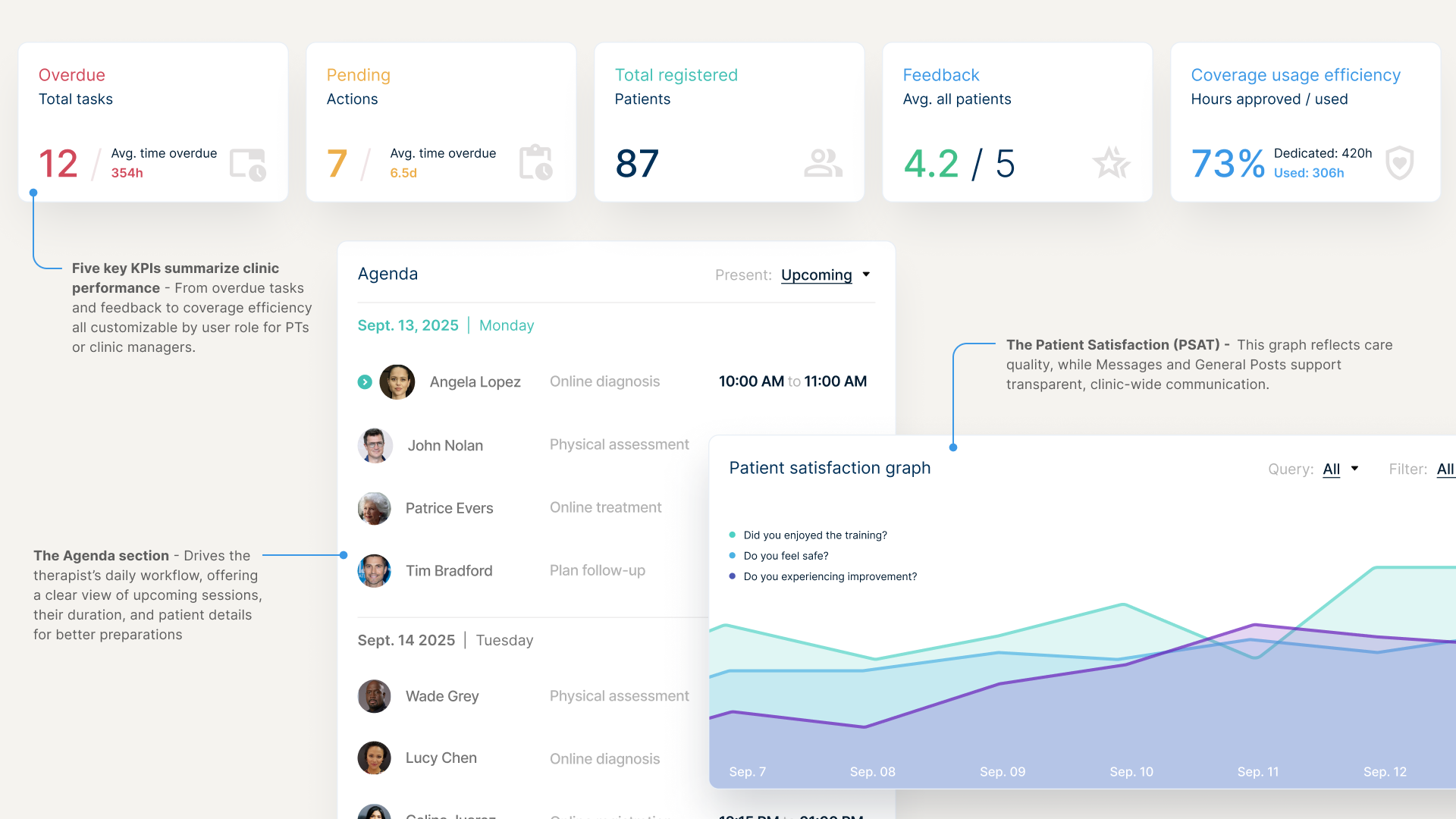
The dashboard serves both clinic managers and physical therapists as a central command center. For managers, it provides a high-level view of the entire operation - tracking insurance coverage efficiency, flagging budget overruns, and surfacing patient satisfaction scores to protect care quality and keep CSAT high. For therapists, the Agenda keeps their daily schedule in clear focus. Both roles benefit from the Message Center, which enables direct communication with individual patients and supports general broadcasts to the entire patient base - making it easy to stay connected, send updates, and receive feedback without leaving the platform.
Step 06
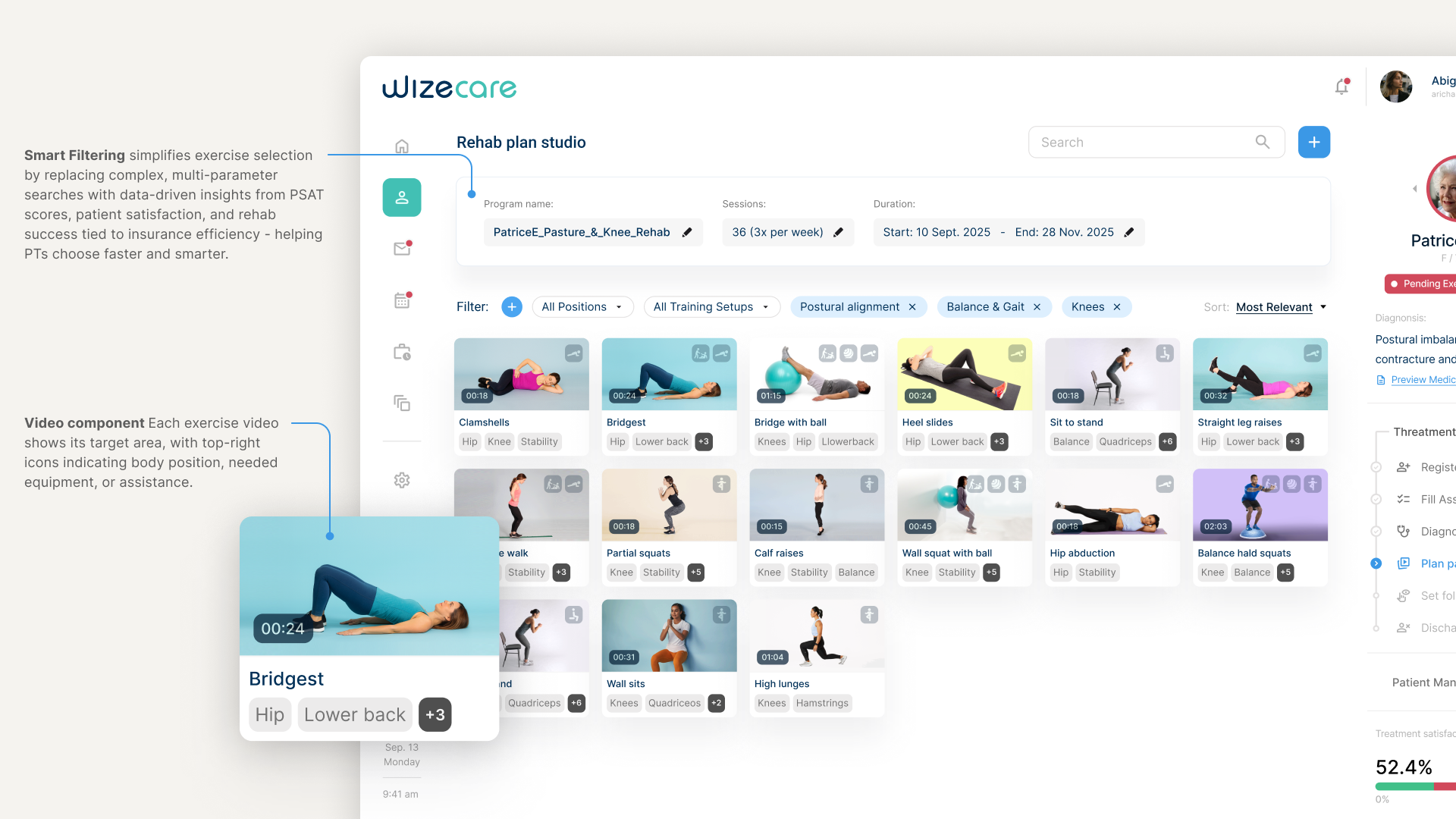
This page allows physical therapists to build, adjust, and monitor personalized rehab programs based on each patient's diagnosis and progress.
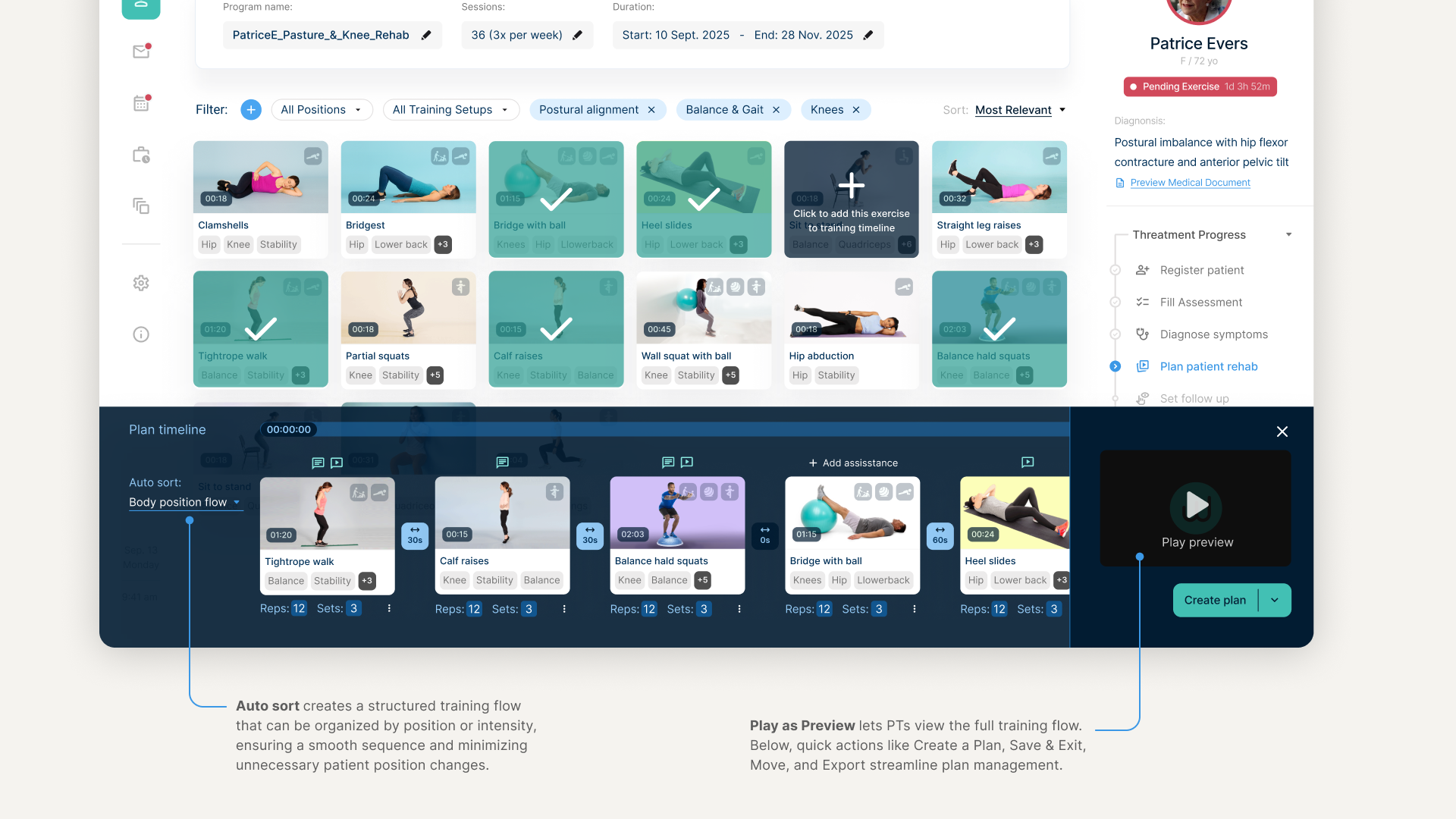
A bottom panel appears once the PT selects at least one exercise, automatically forming a full training flow that can be reviewed, adjusted, and saved as a rehabilitation plan.
Adopted by leading HMOs and health systems, including Clalit, Maccabi, Meuhedet, Cleveland Clinic, and others across the U.S. and Europe.
Customer success wins showing how research and experience drive measurable outcomes.
67%
Cost reduction per patient
+92%
Onboarding success rate
+80%
Enhanced PT capacity vs. in-clinic care
+50%
Patient adherence success
6K+
Patients trusted worldwide
5
New competitors entered the market since 2018 GA - validating the direction